Sunday, 29 April 2012

BUMBLEBEE IDENTIFICATION

There are currently 24 species of bumblebee in the UK. The most common and likely to be seen in gardens are buff-tailed, red-tailed, white-tailed, early, garden, common carder and heath bumblebees. Six of these 24 are cuckoo bumblebees, that parasitise other bumblebees. Three of our bee species have become extinct and several more are threatened.

COMMON BUMBLEBEES

Queens are very large and common in early spring. Workers have a white tail with a hint of buff at the front margin. Yellow bands are slightly darker/dirtier than in the white-tailed bumblebee.
Very common on chalk downland and frequent in gardens. It is distinguishable from the much rarewr red-shanked bumblebee by the black hairs of the pollen basket on the hind legs.
Common bumblebee, often nest under garden sheds. Distinguishable from similar buff-tailed bumblebee by pure white tail and lemon-yellow bands.

Small bee that often nests in tit boxes. The yellow band on the abdomen is sometimes missing in females. Colonies are very short-lived, producing males as early as April. Rarely seen from July onwards.
Very long-tongued bumblebee that prefers deep flowers such as Foxgloves, Delphinium and Honeysuckle. Distinguishable from the generally smaller heath bumblebee by a much longer face when viewed from the front.

Common everywhere, being the only common all-brown bumblebee. Distinguishable from the much rarer brown-banded carder bee by the presence of some black hairs on the sides the abdomen.
Small bee, found on mountains, moorland, lowland heaths and sometimes gardens. Short, heart-shaped face distinguishes it from the larger garden bumblebee. Short-tongued, preferring shallow flowers such as Heather and Cotoneaster.


RARE BUMBLEBEES
Found sporadically in south and east England. The queens are among the largest UK bees. Very variable in colour. Pale specimens are very similar to the garden bumblebee but the yellow band on the rear of the thorax is noticeably thicker in the middle. Entirely black bees are not uncommon and intermediates occur in which the yellow bands are reduced, dark in colour or absent. Has a very long tongue.


Only colonised the UK in 2001 Becoming common in gardens in southern England. Prefers to nest in holes in trees, or even bird boxes. Identifiably by its brown thorax, black abdomen and white tail.
Found mainly in southern England. Distinguished from the common carder by the absence of black hairs on siders of the abdomen, and brownish band across abdomen. Rare southerly species which has declined greatly in recent years. Distinguished from the much more common red-tailed bumblebee by the red hairs of pollen basket on hind leg.This bee weaves grass into a thatch for its nest and is a ground dweller, as are all carder bees.


CUCKOO BUMBLEBEES
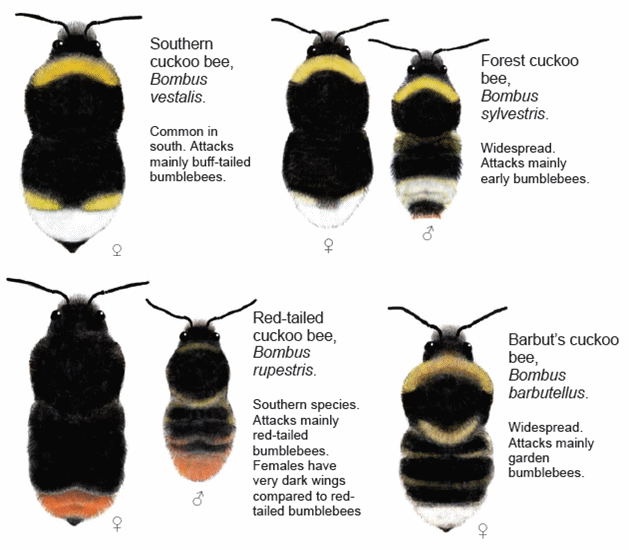
In the UK there are 6 species of cuckoo bumblebees (3 illustrated). These were once like other bumblebees, but they have switched to a parasitic existence. The females kill or evict the queen and take over her workers as their own, using them to rear their own offspring. If you live in the south of England, males of the southern cuckoo bumblebee can be among the most common bumblebees in July and August.Cuckoo bees hang around outside the nest of the bees they are imitating in order to acquire their scent and make it easier for them to get in without a fight. Cuckoo bees only produce queens or males, hence their need to take over a nest and have the workers tend to their needs. However, if the host bee is rare then so is the cuckoo bee for that species. Cuckoo bees have no pollen baskets - they don't need them. They have fewer hairs on their legs, more chitin on their bodies and a longer sting. Cuckoo bees no longer have pollen baskets as they stopped collecting pollen a long time ago. Their legs are just very hairy. They also have darker wings.


MALE OR FEMALE BUMBLEBEE?
Female bumblebees have a concave area on their legs which is shiny and fringed with hairs (for carrying a big bag of pollen). Females have a pointed tip to the abdomen from which the sting emerges. They are literally busy bees, flitting around.
Males have similar legs but with a few hairs. Males also have distinct long antennae, a rounded tip to their abdomen and sit lazily on flowers and DON'T collect pollen. Male antennae are slightly longer than the female's and curved, female antennae have an elbow in them. If you are close enough to check, the male antennae have 13 segments each, the female 12. As males do not collect pollen, they have no pollen baskets on their legs - the only purpose of the males is to mate and then die. Female hind legs have a hook and are hairier. Males often have a yellow face. They are also identifiable from females as they are often dusted with pollen, whereas the female will dust off the pollen with the hook on her leg.

All photos and info courtesy of Bumblee Conservation Trust

Sunday, 8 April 2012

DROUGHT-TOLERANT PLANTS

So, another hosepipe ban comes into force. But this doesn't mean we have to stop planting and making our gardens wildlife-friendly. Many wildflowers are tolerant of drought conditions and therefore will still survive little watering. It goes without saying that waterbutts are invaluable for when we do get a bit of rain so if you can try and dot as many of them as you can around the garden. Below are some wildflowers that are good for insects, very attractive and drought-tolerant.

LESSER KNAPWEED

Lesser Knapweed is particularly attractive to bees and butterflies. We have two large patches in the nursery that have grown into the weed-proof matting and every summer they are smothered in bees and butterflies, especially the little red-bottomed bees. Flowers from June to September. Grows to about 2 ft high.

Particular butterflies that find it attractive are Tortoiseshell and Painted Ladies, and Satyr Pug, Silver Y and Lime Speck Pug moths, and birds like the seeds. Other butterflies – Comma, Silver Washed Fritillary, Marbled White, Meadow Brown, Ringlet, Small Skipper, Essex Skipper, Silver Spotted Skipper, Chalkhill Blue, Adonis, Brimstone.

OX-EYE DAISY

Striking when grown in drifts and looks wonderful with Lesser Knapweed. The word “daisy” comes from two Anglo-Saxon words – daeyes and eayes = day’s eye.

Ox-eye Daisy has quite a bit of folk lore attached to it. It was considered lucky to step on the first flower of the year. Bunches should be picked with your eyes shut and the number of flowers collected would equal the number of years until you married. Somerset folklore connects the Ox-eye Daisy with the Thunder God, so it is sometimes known as Dun Daisy. Ancient peoples dedicated the plant to Artemis, goddess of women, as it was believed that the plant was good for women’s problems. According to ancient Celtic legend, Daisies are the spirits of children who died at birth. Christian legend has it that when the Wise Men were going to see baby Jesus, they asked for a sign to show them his location. As they looked around they saw a group of Ox-eye Daisies near a stable, resembling the star that led them. In the Middle Ages, if a knight wore two Daisies he was the ladies’ choice.

Leaves and outer layer of stem have been used as a sedative, astringent and demulcant. Anti-spasmodic and diuretic. It is also a herbal remedy for whooping cough, asthma and stomach upsets. In Wales during the Middle Ages, Daisies were used to treat madness, smallpox, tumours and jaundice. Makes a good lotion for wounds, bruises and ulcers. Decoction of fresh herb for jaundice. Distilled water made from the flowers can be used as an eye lotion for conjunctivitis.

Herbivorous insects won’t touch Ox-eye Daisy juice so the plant was often mixed with the straw bedding of farm animals and hung from ceilings indoors to repel fleas etc. Dried blossoms can be boiled and used as a lotion for chapped hands. Root stops night sweats in consumption. Alleged to deter flies if planted around the outside of the house.

Flowers May to October, or later.

YARROW

There is alot to say about Yarrow! Hardy perennial growing to about 3 ft (92 cm) in height. Member of the Pink family. Frondy leaves and large panicles of tiny flowers. Also known as Soldiers’ Woundwort, Staunch Grass, Old Man’s Mustard, Devil’s Plaything, Nosebleed, Old Man’s Pepper and Devil’s Nettle (believed to be one of the Devil’s favourite plants). Known as Field Hops in Sweden and has been used to make beer. Yarrow has been around for about 6000 years. The ancient Greeks called it herba militaris, the military herb. The botanical name “millefolium” comes from the Latin meaning thousand cuts, referring to the many cuts of its leaves. Yarrow comes from the Anglo-Saxon “yearwe”. The wild, white form of Yarrow is found in meadows, hedgerows and woodland clearings. The variety we currently offer is in pastel shades. The French call it Carpenter’s Plant as it is believed to instantly cure wounds caused by edged tools.

Place an ounce of Yarrow from a young man’s grace under the pillow of the person you want to fall in love with you. Superstition has it that if a girl tickles her nose with Yarrow and its starts to bleed, then her lover is true to her. More alarming is that Yarrow was used to induce nosebleed by twirling it in the nostrils, as nosebleeds were considered good for curing headache, or a promise of success in love:

“Yarroway, yarroway, bear a white blow If my love love me, my nose will bleed now”

Was tied to cradles to protect babies from witches. The fifteenth-century Book of Secrets by Magnus claims that if Yarrow juice is smeared on the hands and then the hands plunged into water, fish will be drawn to you. It was a plant dedicated to Satan and so used in charms and spells. If eaten at a wedding feast then the happy couple would remain together in love for at least seven years. It was also made into snuff. It was the first herb held in the baby Jesus’ hand.

Keep a bunch of Yarrow hanging in the tool shed for safety and to protect from thieves. Bind it round the handles of tools in case you cut yourself – you can staunch the blood with it. If you lived in Wales you wouldn’t bring Yarrow indoors for fear of incurring a death in the family. In the Hebrides, a leaf held against the eyes will endow you with second sight. If eaten at a wedding feast, the bride and groom would be in love for seven years. Similarly bridesmaids would bring Yarrow to weddings for seven years of love. Druids used the plant’s stems to divine the weather. The plant is potent against fairies. Witches believed that placing sprigs of Yarrow in their caps would give them the ability to fly. Yarrow used to be mixed with pig grease to make a healing ointment. The plant has also been used to treat measles and poxes. It was one of the herbs of the “Lancashire Witches”, one of whom used it in divination.

Good compost activator and fertiliser, and horses like it! Young leaves are edible and nutritious, sometimes used in salads. Its leaves can also be used as a poultice or infused to treat wounds or chewed as a remedy for toothache. Milfoil tea is still drunk in the Orkneys for melancholy. Good dried flower and meadow plant. Attractive to butterflies, ladybirds and wasps that feed on aphids. Food plant of the Essex Emerald, Lime Speck Pug and Straw Belle, Ruby Tiger, Yarrow Pug, V Pug, Grey Pug, Tawny Speckled Pug, Common Pug, Mullein Wave, Wormwood Pug, Sussex Emerald and several Tortricord moths.

The plant is alleged to have got its Latin name from Achilles, who applied Yarrow to the wounds of his bleeding soldiers. Achilles also appealed to the gods for protection before going into battle. They picked him up by the ankle and immersed him in a vat of Yarrow tea but his ankle remained unprotected – hence the term Achilles heel. Yarrow tea is good for colds. The flower tops can be made into a weak infusion as a cleanser for oily skin. The essential oil in Yarrow contains azulene, which has anti-inflammatory properties. It increases perspiration, lowers blood pressure and relieves indigestion. The Irish believe it is lucky if sewn inside clothing. Yarrow ointment is good for bleeding piles. Good rabbit and guinea pig food when plants are young.

In ancient China, 50 dried and stripped Yarrow stalks were consulted as an oracle. Yarrow cools fevers, increases circulation, soothes aching muscles and heals mucous membranes. Added to snuff, it was known as Old Man’s Pepper. Pull off a Yarrow leaf with the left hand saying the name of a sick person you wish to cure. Then eat the leaf and the fever in the patient will fall. Yarrow tea was believed to prevent baldness if rinsed in it.

If planted amongst herbs it will strengthen them and make them more disease-resistant. It will also enhance the essential oils of herbs planted near it. Flowers last well in water.

OTHER DROUGHT-TOLERANT PLANTS TO CONSIDER
Birds Foot Trefoil, Musk Mallow, Selfheal, Sorrel, Bladder Campion, Toadflax, Viper's Bugloss, Lady's Bedstraw and Agrimony.

Therefore, all is not lost! You can still have a garden full of bees, butterflies and flowers even if you water less! Happy planting!

Wednesday, 4 April 2012

BUPA and RSPB's House Sparrow Project


As some of you may know, the house sparrow is in decline.  In order to help reverse this dire situation the RSPB has been trialling a special mix of seed in their house sparrow project, the aim being to boost sparrow numbers. You can read further info on sparrow population trends here.  It is a sad fact that house sparrow numbers have dropped by 55% since the RSPB's first Birdwatch survey in 1979. 

This special mix is a blend of annuals which will provide nectar for the insects that the birds eat.  A component of the mix also provides seeds for birds.  This mix is comprised of the following - linseed, triticale, barley, phacelia, white millet and sunflower.  These provide the seed and insect element.  To enhance the appearance and provide additional nectar, the following cornfield annuals have been added - corn chamomile, corn marigold, corncockle, cornflower, field poppy, scentless mayweed and white campion.

As part of its Wildlife Week (7-13 May), BUPA has teamed up with the RSPB to sow this mix in their 300+ care homes.  Their wildlife week is a week of special activities designed to create wildlife havens in their care home grounds.  If you are interested in what they are doing, or would like to help, please visit BUPA's website for more info.

Our role in this project has been to provide the seeds for the mix.  This mix is now available in our website shop if you would like to create a similar "feeding ground" for the birds in your garden.

Other things you can do to help both the sparrows and other birds:

Put a bird bath in your garden to provide water and a bathing area, even an upturned dustbin lid will do! However, birds will only use it if they feel safe.  They will need to have clear visibility with bushes and trees nearby to fly into for cover if alarmed, and for perching on for preening.  Birds will also visit and try to use water barrels or drinking troughs during periods of drought, which can lead to them drowning so it is a good idea to cover them over if you can or make them safer by placing a branch or blank of wood in the water so they can land, bathe and drink safely.

Put up nest boxes.  Sparrow nest boxes should be placed 2 - 4 metres up a tree, wall or side of house or, even better, under the eaves of a building.  Face the box between north and east away from strong sunlight and rain.  The hole in the box should be no less than 32 mm diameter.

Sow the aforementioned wildlife seed mix.

Create a foraging area of long grass for sparrows in front of shrubs.


Sunday, 25 March 2012

GO PEAT-FREE!

At this time of year, gardeners' thoughts turn to the myriad of jobs that need doing in the garden - including sowing seeds, planting new plants in the garden and potting up patio tubs etc.  However, how many of you will be considering the compost you use?  The majority of people buy their usual multi-purpose compost without a thought to where it comes from.  This compost will inevitably contain peat - unless it is labelled as peat-free.

Peat is dug out from lowland peat bogs - these areas have taken thousands of years to develop and are vital for certain wildflowers such as Sundew, sphagnum moss, Bladderwort, Bog Myrtle and Cotton Grass.  The environment created by these peat bogs is essential for rare dragonflies, spiders and other invertebrates and provide feeding grounds for birds such as plovers, meadow pipits and skylarks. Peatlands occur when waterlogged conditions stop plants from from decomposing properly and the slow build-up of this partly-decomposed material produces peat - this is a slow process, producing at a rate of less than 1 mm a year.

Here's the sad bit - over 94% of these UK peat bogs have been destroyed or damaged and, along with them, the wildlife and wildflowers they support.  This is a staggering amount of destruction.  It is also now realised that peat bogs act as carbon dioxide stores, so disturbing them releases carbon dioxide into the air.  The market for peat-based compost in the UK is responsible for 630,000 tonnes of carbon emissions a year - equivalent to 300,000 extra cars on the road.  Although peat bogs only cover around 3% of the Earth's surface, they store as much carbon as all of the world's forests put together.

As gardeners and people concerned about the state of the environment, you can do your bit to slow down and eventually stop this destruction by not buying peat-based compost.  If your local garden centre doesn't stock a peat-free alternative then ask them if they will consider it.  The more people who asked for peat-free products, the more likely garden centres will start to take notice and stock it.  If your local garden centre does stock it, then please consider buying it if you don't do so already.

Some composts may be labelled as "green" or "organic" - this doesn't mean they are peat-free - they may still contain 70% or so peat.  Check the description carefully to ensure you are buying 100% peat-free.

Vital Earth Carbon Gold, Fertile Fibre, Moorland Gold and Pro-Gro are examples of suppliers of peat-free compost.  In the nursery we use William Sinclair's New Horizon coir compost, made from coco-fibre.

Armed now with the basics of how your peat-based compost is contributing to a biodiversity crisis, how can you not go peat-free next time you need compost?


Cotton Grass photographed on Hothfield Common near Ashford in Kent.  Hothfield Common contains Kent's last four valley bogs and is a site of Special Scientific Interest.


Wednesday, 14 March 2012

Wildlife Stack

We spent a couple of very pleasant hours the other weekend creating a wildlife stack near the pond, also known as an insect hotel, bug hotel amongst other titles.  Most photos of these stacks that you see online use pallets as the basis for the framework.  However, my husband was having none of that, hating the look of pallets, and said it would have to be more rustic than that.  So off he went to raid the log store.

The pond area is an ideal spot to site as it has some sun and some shade and will also provide refuge for any newts or frogs.  A pallet was allowed as the base and this had a layer of widely-spaced logs placed on it.  This was filled with twigs, long pieces of dead grass, small terracotta pots, dried leaves etc.  Another layer of logs and some cardboard was put on next and filled again.  This process was repeated until we had a stack about 1 m square.

We added mason bee nests on the more sheltered side (the little wooden houses in the photo below) and lots more logs and tubes and foliage for all sorts of creatures.  We also added bits of slate and brick, the aim being to provide as many type of nooks and crannies as possible!  The gap under the pallet base will also provide shelter for amphibians, and, for good measure, we put a broken terracotta pot sideways on as a possible home for frogs.


The top of the stack was finished off with a piece of thick board covered in some spare pondliner we had.  This was edged with logs and the middle filled with soil.  Wildflowers have been planted in this  (Wild Pansy, Ivy-leaved Toadflax, Chamomile) and a couple more structures added on the top - an old chimney pot filled with bee nesting tubes and a small bug house.  Wildflowers were also planted around the base of the structure (Red Campion, Ox-eye Daisy and Viper's Bugloss) so that in the summer it will look glorious and colourful and blend into the site more.  It should also have many residents such as spiders, bees, lacewings, ladybirds, beetles etc.  Everything the stack was made from was recycled from bits and pieces we found in the shed and garden so it didn't cost a penny!  I will update you on creatures using the stack and how it looks in the summer.

Our stack is quite big but it doesn't have to be this big if your garden does not have much room - any size will be useful to the wildlife it will attract.


Friday, 24 February 2012

End of February 2012

Well, what a difference a couple of weeks make!  Only that short time ago we were under 4 inches of snow, now the temperature is edging towards 18 degrees!  Makes me very impatient for spring and summer!  The wildflower nursery is now in full flow, with seeds being sowed and plants that are looking a bit sorry being potted on to give them a new lease of life and room to stretch their legs.

Some of the plants did not manage to survive the snow, for example, the Cats Ear plugs were ruined but we did have some in the greenhouse so hopefully they will pick up as they didn't seem to suffer so much.
 The Wild primroses are looking very lush and as thought hey are thoroughly enjoying this first taster of spring!

Many trays of seeds were sown yesterday - Red Clover, Birdsfoot Trefoil, Wild Carrot, Lesser Knapweed - to name but a few!  In a few weeks these should be putting in an appearance, as long as the field mice don't realise they are there!  They can munch through trays of seeds in just one night.  However, the greenhouse is very secure so as long as none have sneaked in during the day things should be OK.

 In front of the "potting shed" is an area of stony soil which had been covered in black weed suppressant.  This matting was removed at the end of last summer to see what would self-sow there.  Already I can see red Clover, Toadflax, Hemp nettle, White Clover, Willowherb and Deptford Pink.  I think this is going to be a lovely little meadow area in the summer, although it is overshadowed by a very tall hedge.  So it will be interesting to see how it develops.

We have also been busy packing orders, particularly wildlflower Gromats.  These mats are so easy to us - just lay them out, cover with compost and water!  We have sold many of these so if you are one of those people who bought one we'd be interested to see how your mat grew!  we are also trialling some of the seed papers we sell to see just how well they germinate.  So far things are looking good as the Lokta, seeded card and seeded petal papers are starting to germinate.


I also did a quick check of all the trees in the garden for signs of mistletoe. Two years ago a friend came round with a pot of very sticky mistletoe berries and  "glued" them onto various trees.  Finally, there are signs of germination as I found two patches on the old apple tree!  Very exciting!  They even survived the arctic conditions recently so I have high hopes for them!

Well, off to pack more orders now.  And by the way, just thought I'd mention i saw the first honeybee of the year in the garden flitting in and out of the snowdrop flowers!

Tuesday, 14 February 2012

This and that ...

Well, the snow certainly put paid to any gardening or nursery activities for a couple of weeks.  However, it has practically all gone now so maybe things can get back to normal a bit more now as we head towards spring.  However, things did look magical for a time, covered in white.  Even the most mundane hedge looked beautiful.


This hedge is mainly Hawthorn and you can see on the right hand side the fluffy seedheads of Wild Clematis winding its way through it.  Even the wildflowers still lurking through winter look brilliant in the snow (Teasels):


The birds have been a-twittering like mad in the mornings now and we have had many on the feeders, usually bluetits, chaffinches, great tits plus the usual motley crew of robins and blackbirds.  We have a number of feeders around the garden and nursery and they are well populated with birds.  Have just started seeing the odd Blackcap and Bullfinch too coming to visit.  Woodpeckers are always on the peanuts!


The top feeder was made from an old log we found in the shed which had an interesting shape and hammered into the ground near the conservatory.  However, this then had to be moved a few days later because birds kept flying into the conservatory!  This many-branched feeder is a shop bought one placed near the hedge so that the birds feel safe and they are constantly flitting between the hedge and the feeders.


Lovely little blue tit caught with a sunflower seed propping open his beak!

Aside from the birds we also make sure that any lizards or aquatic wildlife from the pond has a bit of shelter and we have a couple of log piles dotted around the pond area to provide a bit of shelter.


The mason bees and other insects are also well provided for with a number of next boxes placed on various walls around the garden and nursery:


This insect shelter has drilled logs and hollow bamboo to encourage mason bees to nest.  Some of the holes have been filled by them last year but they didn't seem to find this box for quite a while and by then had filled up all the purpose-built nest tubes fixed up elsewhere.  Hopefully more will discover this box this year.  The rest of the box has pine cones and bark for all sorts of other insects to crawl into and live.

It doesn't cost a lot to set up a haven for wildlife in your garden and you will be rewarded with hours of splendidness watching the birds, bees, butterflies and whatever else decides to come and visit your garden!