Tuesday, 19 June 2012

WILDLIFE HABITATS IN OUR GARDEN

Our garden is surrounded by fields of oats at the moment. A native hedge separates the fields from our garden. Some of this was planted three years ago, the part at the front much further in the past. We have a good selection of Rowan, Crab Apple, Hornbeam, Hawthorn, Spindle, Privet and Elder - all excellent for a variety of creatures. Fruits for the mice, voles and birds, flowers for the bees, butterflies and moths and places for the birds to nest and shelter. The front part of the hedge is entwined with Wild Rose, White Bryony and Wild Clematis. If you have Privet i your hedge, try and leave it to flower rather than trimming it - you will be amazed at the butterflies and bees you will get on the flowers!


Not only is a hedge is marvellous habitat for wildlife. The wildflowers in front of it are also just as marvellous. Red Campion adds a splash of pink and there are always bees on the flowers. Comfrey is another plant that like the semi-shade conditions provided by a hedge - and is another plant beloved of bees. As is Hedge Woundwort with its spires of purple-red flowers and its downy, nettle-like leaves.


The hedgerow in the field next door also has Bladder Campion and Blackberries growing alongside it, with the odd Teasel which has self-seeded next to it.

We also have two ponds next to each other. The first, smaller one was dug a year before the second. This has become rather overgrown with Cotton Grass, Yellow Flag Iris and other pond grasses. Willowherb has also taken a liking to it. When there hasn't been much rain this area becomes more of a bog now than a pond but it still has plenty of wildlife value. Purple Loosestrife grows beside its edges and when in flower is full of butterflies and bees. The main pond next to it is full of native oxygenators, a couple of Lilies, Bogbean, Water Forget-me-not, water snails, water boatmen and,at this time of year, dragonflies and damselflies. The colour of these creatures is vibrant and breathtaking.The two photos below show the pond two years ago when first dug and how it is now.


Leading up to the pond is our meadow area - every year this is different. The first year we sowed cornfield annuals and left it to set seed. We also planted a number of perennial wildflowers. The following two years we left it and just added extra plants, scattered a few seeds and then waited to see what would appear. This year we have Lesser Knapweed, Oxeye Daisy, Catmint, White Campion, Sorrel, Elecampane, Purple Loosestrife, Ragged Robin, Marshmallow - to name but a few and there are still more to come. As I write it is mainly white but this will soon change with the addition of pinks, blues and reds. The area is buzzing with bees, hoverflies, butterflies, moths and other flying creatures. I saw a slow worm there yesterday and a few weeks ago a couple of ducks flew in and spent the day floating about on the water or sitting by the pond. We have mown some paths to gain access to the pond and the whole meadow area is loosely enclosed with widely-spaced trees and shrubs. An rusted archway is the entrance to the area and this is slowly getting covered with honeysuckle, climbing roses and hops.

The front of the meadow area is just rough grass but, despite that, clovers and Wild Carrot have sown themselves there and soon that area will be a splash of white with the Wild Carrot flowerheads.


We made a wildlife stack (see blog earlier in the year)in February out of logs, old pots, hay etc and planted the top with wildflowers. We built it close to the far side of the pond next to a "grove" of Silver Birch trees. This area is now smothered in wispy tall grasses but the stack can be seen through them and I should imagine many creatures have made a home in it.


Also amongst the meadow area are two piles of logs acting as wildlife refuges, initially for frogs but we have had no frogs this year. But I would guess it is a pretty popular area for slow worms and maybe the odd grass snake which has been seen amongst the grasses. A patch has also been dug in the grass area for growing Kidney Vetch, a food plant that blue butterflies love. Having seen one or two of them flitting about I am hoping this patch in flower will encourage them to stay! I sowed California Poppies in between the plants as they are good nectar plants, although not native wildflowers to the UK.


To the right of the meadow area is a pergola which we have planted with various Honeysuckles and Clematis to provide eventually a nice sheltered seating area. This too is surrounded by grasses, Ox-eye Daisies, Red Campion and Meadow Clary.


In front of all of this is a very tall, majestic Hornbeam, a micro-habitat in its own right, catering for insects (particularly moths), birds and squirrels. Around 28 species of wildlife are supported by Hornbeam trees. A tawny owl took quite a shine to the tree last autumn and sat in there every night shrieking for about three weeks. I loved listening to it! The area under the tree is awash with Bluebells, Oxlips and Cyclamen in the spring.

This brings us to the front of the house which is mainly laid to lawn but a wildflower patch under the kitchen window adds a splash of colour - this changes every year as I generally leave it to do its own thing.


Part of the back and edge of the house has an older Wisteria climbing up it. When you walk through the leafy archway beside it you are greeted with intense humming coming from a swarm of honeybees that arrived three weeks ago and set up home in a space into the wall that they managed to discover through the Wisteria! However they are doing no harm and I quite like listening to them and watching them at work as I walk by.


At the far end of the front garden is a shady, sheltered area which has Primroses, Red Campion, Bluebells, Snowdrops and Ground Ivy. Definitely at its best in spring but still a good little habitat.


I would urge everyone to give over a little bit of their garden to creating one or two wildlife habitats. It brings immense pleasure to sit amongst it all and watch and listen to the creatures it attracts getting on with their daily lives. Even a sunken bowl of water will bring in new wildlife! When we moved here the garden was very bland. It is now home to many species of bee, butterfly, moth, bird and bat. We are also plagued with rabbits sometimes, which can be annoying when they eat what you have just planted, and the squirrels can be annoying when they eat all the bird food but - I wouldn't have it any other way.

Friday, 1 June 2012

RE-INTRODUCTION OF THE SHORT-HAIRED BUMBLEBEE

I was very lucky to be invited along to the reintroduction of this extinct British bumblebee. The bee was last recorded in the UK in 1988 and officially declared extinct in 2000. Its demise is the result of farming, the use of pesticides etc and the destruction of hedgerows to make way for vast fields of crops. Scientists have been working for the last three years on reintroducing this species into the UK and the day finally arrived for the reintroduction on 28 May 2012 at the RSPB Dungeness nature reserve! The project has been a collaberation of Hymettus, Natural England and the RSPB. There has also been a lot of liaison with local farmers on Romney Marsh and the sowing of swathes of marshland with the wildflower species that the bee needs in order to survive.

Dr Nikki Gammans has been key to the whole project and she and colleagues went over to Skane in Sweden earlier this year to collect Short-haired bumblebee queens to release in the UK. Sweden has a large Short-haired bumblebee population and after negotiations with the Swedish scientists etc it was agreed that the team could collect some bees to release in the UK. The bees were caught in nets, placed in vials and housed in fridges at 5 degrees to calm them and they were fed for 5 days on a nectar solution. Once in the UK, strict quarantine was observed for two weeks to make sure no parasites had been brought back with the bees. Some bees sadly died from parasite infestation but 51 survived.


Dungeness (2 photos above) was chosen as the release site as the bee had previously been recorded there and its climatic conditions and native flora were ideal and similar to those in Skane. Dungeness is a fascinating place, a shingle habitat. Shingle habitats are rare worldwide and Dungeness has 40% of the UKs shingle reserve. Dungeness has three distinct habitats - young shingle, lichen heath and wild grassland. This results in a rich biodiversity in the area, with over 500 species of wildlife recorded there. It is a national nature reserve and a site of special scientific interest.

On the release day, the British media did a stirling job in keeping the event in the public eye all day via radio and TV news bulletins. The RSPB centre in Dungeness was a hive of activity with film crews and people invited along to witness the event. After all the media interviews, the process of releasing the bees could then get underway. Nikki went off to her campervan to get the bees out of the fridge and they were handed out in cool bags to four group leaders to be released at four different sites.


The group I was in went off across the shingle to a patch of Yellow Flag Irises and the queens were taken out of the cool bag in their plastic boxes and vials. We had 8 of the 51. As they warmed up they started to get a bit feisty and were keen to be off!
One by one the boxes and vials were opened and the bees started to clamber out. Once they realised freedom was to be had, they were off! Some still needed to warm up a bit so were happy to sit on someone's hands to absorb the heat. It was a splendid moment and one I won't forget, watching them fly off to freedom and a new life, and hopefully to multiply in numbers across the surrounding area.
It was a lovely sight watching the bees fly off into the flowers and we could occasionally spot them as they went from flower to flower. It was quite an idyllic scene - warm weather, clear blue skies, reed warblers singing their hearts out and a couple of cuckoos flying around!


The story doesn't end there. The bee's progress will be closely monitored and more queens are planned for collection and release over the next two or three years. Truly a conservation success so far.


Monday, 21 May 2012

BUMBLEBEE RESCUE!

Just a short blog this time as I am flat out with orders at the moment and there do not seem to be enough hours in the day! I found this small female bee (female bees have bent antennae so I was able to identify!)on the floor of the conservatory, very weak and not moving. I made up a sugar solution (50:50 water and sugar) and put a teaspoonful on the floor in front of her - if bees are weak like this it is probably because they are exhausted and need a bit of a battery recharge to get them on their way again - sugar solution is great for this! The bee immediately began sucking the water up through her proboscis, which you can clearly see in the photo. She then rested about ten minutes, drank some more, rested about five minutes and then took to the air and buzzed off out the door, full of energy again!

I felt very pleased with my good deed!

Monday, 7 May 2012

WILDFLOWERS DOWN OUR LANE

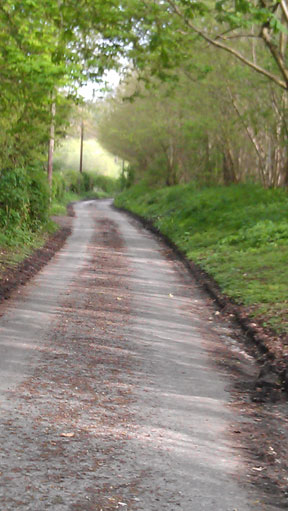
Our lane is a narrow, quiet country lane and is full of wildflowers at this time of year (April/May). The verges have been left to do their own thing and are a shimmer of mainly purple and white, buzzing with bumblebees.

Cow Parsley A very pretty white wildflower also known as Queen Anne's Lace, Fairy Lace and Gipsy's Umbrella. Likes sun or partial shade.


Ground Ivy Creeping wildflower often found at the base of hedges, with masses of small purple flowers.It does have medicinal properties (always check with a qualified herbalist before using!) and was believed to protect against sorcery.


White Deadnettle A great favourite of bumblebees! Leaves are very much like those of stinging nettle (without the stings!) and whorls of white flowers. It grows in drifts down the lane and there's always some buzzing to hear as you walk past!


Hemp Nettle Very common wildflower, again liked by bees. However, to most people it is probably just an annoying weed, but if you look at the small pink flowers closely they are really very intricate and pretty.


Yellow Archangel Another creeping perennial wildflowers, again loved by bees. A bit like a yellow White Deadnettle! Whorls of yellow flowers and vaguely striped leaves. Good ground cover for a shady spot. Food plant of the Yellow Speckled moth.


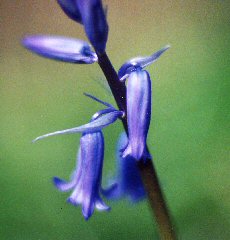
English Bluebells The beautiful native English Bluebell! There is a little wooded area that the lane cuts through and this is starting to be carpeted in Bluebells. Moth, butterfly and bee nectar plant. Not to be confused with Bluebells in Scotland, a name which often refers to Harebells and not Bluebells.


Lesser Celandine Low-growing wildflower with open-faced yellow flowers. Food plant of the Flame Brocade moth. Some medicinal uses - again, consult a qualified herbalist before using!

Alkanet I love this wildflower! It has beautiful skyblue flowers and grows in clumps dotted down the lane.


Greater Stitchwort Lovely starry white flowers on this sprawling wildflower. Brightens up any hedgerow!


Dog Violet Dainty little mauve wildflower, nestling under hedges. Similar to Sweet Violet but has no scent.


Wild Clematis After a winter as just bare stems and twigs, this wildflower has now sprung into action and is smothered in leaves. It is creeping along the top of the hedgerows and will soon be smothered in small white flowers. Loved by moths, eg, Chalk Carpet, Lime Speck Pug, Haworth’s Pug, Small Emerald, The Fern, Pretty Chalk Carpet, Least Carpet and Small Waved Umber moths, hoverflies and bees.

Sunday, 29 April 2012

BUMBLEBEE IDENTIFICATION

There are currently 24 species of bumblebee in the UK. The most common and likely to be seen in gardens are buff-tailed, red-tailed, white-tailed, early, garden, common carder and heath bumblebees. Six of these 24 are cuckoo bumblebees, that parasitise other bumblebees. Three of our bee species have become extinct and several more are threatened.

COMMON BUMBLEBEES

Queens are very large and common in early spring. Workers have a white tail with a hint of buff at the front margin. Yellow bands are slightly darker/dirtier than in the white-tailed bumblebee.
Very common on chalk downland and frequent in gardens. It is distinguishable from the much rarewr red-shanked bumblebee by the black hairs of the pollen basket on the hind legs.
Common bumblebee, often nest under garden sheds. Distinguishable from similar buff-tailed bumblebee by pure white tail and lemon-yellow bands.

Small bee that often nests in tit boxes. The yellow band on the abdomen is sometimes missing in females. Colonies are very short-lived, producing males as early as April. Rarely seen from July onwards.
Very long-tongued bumblebee that prefers deep flowers such as Foxgloves, Delphinium and Honeysuckle. Distinguishable from the generally smaller heath bumblebee by a much longer face when viewed from the front.

Common everywhere, being the only common all-brown bumblebee. Distinguishable from the much rarer brown-banded carder bee by the presence of some black hairs on the sides the abdomen.
Small bee, found on mountains, moorland, lowland heaths and sometimes gardens. Short, heart-shaped face distinguishes it from the larger garden bumblebee. Short-tongued, preferring shallow flowers such as Heather and Cotoneaster.


RARE BUMBLEBEES
Found sporadically in south and east England. The queens are among the largest UK bees. Very variable in colour. Pale specimens are very similar to the garden bumblebee but the yellow band on the rear of the thorax is noticeably thicker in the middle. Entirely black bees are not uncommon and intermediates occur in which the yellow bands are reduced, dark in colour or absent. Has a very long tongue.


Only colonised the UK in 2001 Becoming common in gardens in southern England. Prefers to nest in holes in trees, or even bird boxes. Identifiably by its brown thorax, black abdomen and white tail.
Found mainly in southern England. Distinguished from the common carder by the absence of black hairs on siders of the abdomen, and brownish band across abdomen. Rare southerly species which has declined greatly in recent years. Distinguished from the much more common red-tailed bumblebee by the red hairs of pollen basket on hind leg.This bee weaves grass into a thatch for its nest and is a ground dweller, as are all carder bees.


CUCKOO BUMBLEBEES
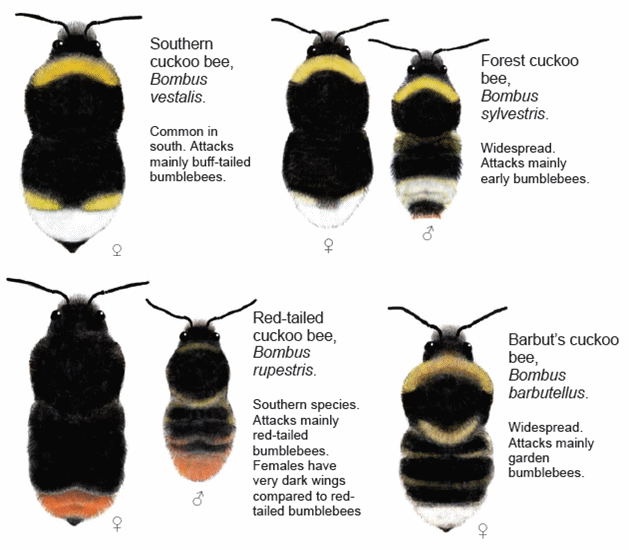
In the UK there are 6 species of cuckoo bumblebees (3 illustrated). These were once like other bumblebees, but they have switched to a parasitic existence. The females kill or evict the queen and take over her workers as their own, using them to rear their own offspring. If you live in the south of England, males of the southern cuckoo bumblebee can be among the most common bumblebees in July and August.Cuckoo bees hang around outside the nest of the bees they are imitating in order to acquire their scent and make it easier for them to get in without a fight. Cuckoo bees only produce queens or males, hence their need to take over a nest and have the workers tend to their needs. However, if the host bee is rare then so is the cuckoo bee for that species. Cuckoo bees have no pollen baskets - they don't need them. They have fewer hairs on their legs, more chitin on their bodies and a longer sting. Cuckoo bees no longer have pollen baskets as they stopped collecting pollen a long time ago. Their legs are just very hairy. They also have darker wings.


MALE OR FEMALE BUMBLEBEE?
Female bumblebees have a concave area on their legs which is shiny and fringed with hairs (for carrying a big bag of pollen). Females have a pointed tip to the abdomen from which the sting emerges. They are literally busy bees, flitting around.
Males have similar legs but with a few hairs. Males also have distinct long antennae, a rounded tip to their abdomen and sit lazily on flowers and DON'T collect pollen. Male antennae are slightly longer than the female's and curved, female antennae have an elbow in them. If you are close enough to check, the male antennae have 13 segments each, the female 12. As males do not collect pollen, they have no pollen baskets on their legs - the only purpose of the males is to mate and then die. Female hind legs have a hook and are hairier. Males often have a yellow face. They are also identifiable from females as they are often dusted with pollen, whereas the female will dust off the pollen with the hook on her leg.

All photos and info courtesy of Bumblee Conservation Trust

Sunday, 8 April 2012

DROUGHT-TOLERANT PLANTS

So, another hosepipe ban comes into force. But this doesn't mean we have to stop planting and making our gardens wildlife-friendly. Many wildflowers are tolerant of drought conditions and therefore will still survive little watering. It goes without saying that waterbutts are invaluable for when we do get a bit of rain so if you can try and dot as many of them as you can around the garden. Below are some wildflowers that are good for insects, very attractive and drought-tolerant.

LESSER KNAPWEED

Lesser Knapweed is particularly attractive to bees and butterflies. We have two large patches in the nursery that have grown into the weed-proof matting and every summer they are smothered in bees and butterflies, especially the little red-bottomed bees. Flowers from June to September. Grows to about 2 ft high.

Particular butterflies that find it attractive are Tortoiseshell and Painted Ladies, and Satyr Pug, Silver Y and Lime Speck Pug moths, and birds like the seeds. Other butterflies – Comma, Silver Washed Fritillary, Marbled White, Meadow Brown, Ringlet, Small Skipper, Essex Skipper, Silver Spotted Skipper, Chalkhill Blue, Adonis, Brimstone.

OX-EYE DAISY

Striking when grown in drifts and looks wonderful with Lesser Knapweed. The word “daisy” comes from two Anglo-Saxon words – daeyes and eayes = day’s eye.

Ox-eye Daisy has quite a bit of folk lore attached to it. It was considered lucky to step on the first flower of the year. Bunches should be picked with your eyes shut and the number of flowers collected would equal the number of years until you married. Somerset folklore connects the Ox-eye Daisy with the Thunder God, so it is sometimes known as Dun Daisy. Ancient peoples dedicated the plant to Artemis, goddess of women, as it was believed that the plant was good for women’s problems. According to ancient Celtic legend, Daisies are the spirits of children who died at birth. Christian legend has it that when the Wise Men were going to see baby Jesus, they asked for a sign to show them his location. As they looked around they saw a group of Ox-eye Daisies near a stable, resembling the star that led them. In the Middle Ages, if a knight wore two Daisies he was the ladies’ choice.

Leaves and outer layer of stem have been used as a sedative, astringent and demulcant. Anti-spasmodic and diuretic. It is also a herbal remedy for whooping cough, asthma and stomach upsets. In Wales during the Middle Ages, Daisies were used to treat madness, smallpox, tumours and jaundice. Makes a good lotion for wounds, bruises and ulcers. Decoction of fresh herb for jaundice. Distilled water made from the flowers can be used as an eye lotion for conjunctivitis.

Herbivorous insects won’t touch Ox-eye Daisy juice so the plant was often mixed with the straw bedding of farm animals and hung from ceilings indoors to repel fleas etc. Dried blossoms can be boiled and used as a lotion for chapped hands. Root stops night sweats in consumption. Alleged to deter flies if planted around the outside of the house.

Flowers May to October, or later.

YARROW

There is alot to say about Yarrow! Hardy perennial growing to about 3 ft (92 cm) in height. Member of the Pink family. Frondy leaves and large panicles of tiny flowers. Also known as Soldiers’ Woundwort, Staunch Grass, Old Man’s Mustard, Devil’s Plaything, Nosebleed, Old Man’s Pepper and Devil’s Nettle (believed to be one of the Devil’s favourite plants). Known as Field Hops in Sweden and has been used to make beer. Yarrow has been around for about 6000 years. The ancient Greeks called it herba militaris, the military herb. The botanical name “millefolium” comes from the Latin meaning thousand cuts, referring to the many cuts of its leaves. Yarrow comes from the Anglo-Saxon “yearwe”. The wild, white form of Yarrow is found in meadows, hedgerows and woodland clearings. The variety we currently offer is in pastel shades. The French call it Carpenter’s Plant as it is believed to instantly cure wounds caused by edged tools.

Place an ounce of Yarrow from a young man’s grace under the pillow of the person you want to fall in love with you. Superstition has it that if a girl tickles her nose with Yarrow and its starts to bleed, then her lover is true to her. More alarming is that Yarrow was used to induce nosebleed by twirling it in the nostrils, as nosebleeds were considered good for curing headache, or a promise of success in love:

“Yarroway, yarroway, bear a white blow If my love love me, my nose will bleed now”

Was tied to cradles to protect babies from witches. The fifteenth-century Book of Secrets by Magnus claims that if Yarrow juice is smeared on the hands and then the hands plunged into water, fish will be drawn to you. It was a plant dedicated to Satan and so used in charms and spells. If eaten at a wedding feast then the happy couple would remain together in love for at least seven years. It was also made into snuff. It was the first herb held in the baby Jesus’ hand.

Keep a bunch of Yarrow hanging in the tool shed for safety and to protect from thieves. Bind it round the handles of tools in case you cut yourself – you can staunch the blood with it. If you lived in Wales you wouldn’t bring Yarrow indoors for fear of incurring a death in the family. In the Hebrides, a leaf held against the eyes will endow you with second sight. If eaten at a wedding feast, the bride and groom would be in love for seven years. Similarly bridesmaids would bring Yarrow to weddings for seven years of love. Druids used the plant’s stems to divine the weather. The plant is potent against fairies. Witches believed that placing sprigs of Yarrow in their caps would give them the ability to fly. Yarrow used to be mixed with pig grease to make a healing ointment. The plant has also been used to treat measles and poxes. It was one of the herbs of the “Lancashire Witches”, one of whom used it in divination.

Good compost activator and fertiliser, and horses like it! Young leaves are edible and nutritious, sometimes used in salads. Its leaves can also be used as a poultice or infused to treat wounds or chewed as a remedy for toothache. Milfoil tea is still drunk in the Orkneys for melancholy. Good dried flower and meadow plant. Attractive to butterflies, ladybirds and wasps that feed on aphids. Food plant of the Essex Emerald, Lime Speck Pug and Straw Belle, Ruby Tiger, Yarrow Pug, V Pug, Grey Pug, Tawny Speckled Pug, Common Pug, Mullein Wave, Wormwood Pug, Sussex Emerald and several Tortricord moths.

The plant is alleged to have got its Latin name from Achilles, who applied Yarrow to the wounds of his bleeding soldiers. Achilles also appealed to the gods for protection before going into battle. They picked him up by the ankle and immersed him in a vat of Yarrow tea but his ankle remained unprotected – hence the term Achilles heel. Yarrow tea is good for colds. The flower tops can be made into a weak infusion as a cleanser for oily skin. The essential oil in Yarrow contains azulene, which has anti-inflammatory properties. It increases perspiration, lowers blood pressure and relieves indigestion. The Irish believe it is lucky if sewn inside clothing. Yarrow ointment is good for bleeding piles. Good rabbit and guinea pig food when plants are young.

In ancient China, 50 dried and stripped Yarrow stalks were consulted as an oracle. Yarrow cools fevers, increases circulation, soothes aching muscles and heals mucous membranes. Added to snuff, it was known as Old Man’s Pepper. Pull off a Yarrow leaf with the left hand saying the name of a sick person you wish to cure. Then eat the leaf and the fever in the patient will fall. Yarrow tea was believed to prevent baldness if rinsed in it.

If planted amongst herbs it will strengthen them and make them more disease-resistant. It will also enhance the essential oils of herbs planted near it. Flowers last well in water.

OTHER DROUGHT-TOLERANT PLANTS TO CONSIDER
Birds Foot Trefoil, Musk Mallow, Selfheal, Sorrel, Bladder Campion, Toadflax, Viper's Bugloss, Lady's Bedstraw and Agrimony.

Therefore, all is not lost! You can still have a garden full of bees, butterflies and flowers even if you water less! Happy planting!

Wednesday, 4 April 2012

BUPA and RSPB's House Sparrow Project


As some of you may know, the house sparrow is in decline.  In order to help reverse this dire situation the RSPB has been trialling a special mix of seed in their house sparrow project, the aim being to boost sparrow numbers. You can read further info on sparrow population trends here.  It is a sad fact that house sparrow numbers have dropped by 55% since the RSPB's first Birdwatch survey in 1979. 

This special mix is a blend of annuals which will provide nectar for the insects that the birds eat.  A component of the mix also provides seeds for birds.  This mix is comprised of the following - linseed, triticale, barley, phacelia, white millet and sunflower.  These provide the seed and insect element.  To enhance the appearance and provide additional nectar, the following cornfield annuals have been added - corn chamomile, corn marigold, corncockle, cornflower, field poppy, scentless mayweed and white campion.

As part of its Wildlife Week (7-13 May), BUPA has teamed up with the RSPB to sow this mix in their 300+ care homes.  Their wildlife week is a week of special activities designed to create wildlife havens in their care home grounds.  If you are interested in what they are doing, or would like to help, please visit BUPA's website for more info.

Our role in this project has been to provide the seeds for the mix.  This mix is now available in our website shop if you would like to create a similar "feeding ground" for the birds in your garden.

Other things you can do to help both the sparrows and other birds:

Put a bird bath in your garden to provide water and a bathing area, even an upturned dustbin lid will do! However, birds will only use it if they feel safe.  They will need to have clear visibility with bushes and trees nearby to fly into for cover if alarmed, and for perching on for preening.  Birds will also visit and try to use water barrels or drinking troughs during periods of drought, which can lead to them drowning so it is a good idea to cover them over if you can or make them safer by placing a branch or blank of wood in the water so they can land, bathe and drink safely.

Put up nest boxes.  Sparrow nest boxes should be placed 2 - 4 metres up a tree, wall or side of house or, even better, under the eaves of a building.  Face the box between north and east away from strong sunlight and rain.  The hole in the box should be no less than 32 mm diameter.

Sow the aforementioned wildlife seed mix.

Create a foraging area of long grass for sparrows in front of shrubs.